
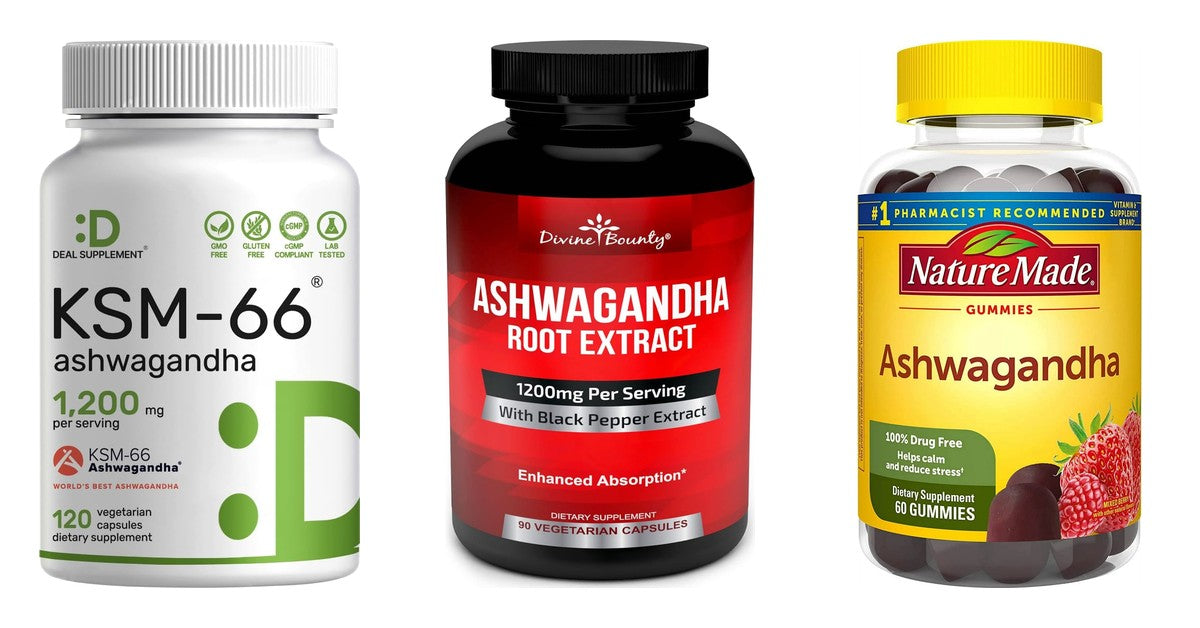
Six ashwagandha labels sit on our shelf, and three put a milligram figure on the front: “1,200 mg” and “per serving” on one capsule bottle, “1200mg Per Serving” on another, “450mg 10:1 extract” on a third. The other three print no front dose: a gummy, a one-capsule bottle, and a two-tablet product in which ashwagandha is one line inside a blend. The figures only line up on the Supplement Facts line under each front, where the serving size (one gummy to three capsules) and the material named (root, root extract, a 10:1 extract, a branded extract) change from label to label. This guide turns every figure into a per-piece number and lists which panels print a withanolide percentage. The sums are the whole of it; what ashwagandha does is not a label question.
Six labels, six serving lines
Here is each ashwagandha line as printed.
| Label | Serving size and ashwagandha per serving |
|---|---|
| Nature Made KSM-66 Ashwagandha Gummies | 1 gummy: 150 mg KSM-66 root extract |
| Thorne Ashwagandha Capsules | 1 capsule: 120 mg extract (root, leaf) |
| Deal Supplement KSM-66 Ashwagandha 1200 mg | 3 capsules: 1,200 mg KSM-66 extract (root) |
| Divine Bounty Ashwagandha 1200 mg | 2 capsules: 1200 mg organic root |
| Horbäach Ashwagandha with Black Pepper | 3 capsules: 450 mg 10:1 extract (root) |
| Integrative Therapeutics Cortisol Manager | 2 tablets: inside a 500 mg blend, no figure |
Divided by the pieces in a serving, the five printed figures become: Deal Supplement 1,200 mg ÷ 3 = 400 mg per capsule; Divine Bounty 1200 mg ÷ 2 = 600 mg per capsule; Horbäach 450 mg ÷ 3 = 150 mg per capsule; Nature Made 150 mg per gummy and Thorne 120 mg per capsule, both already printed per piece. Cortisol Manager has no per-piece figure to divide. The five numbers share a unit, not a material.
Two fronts say 1,200 mg per serving; the panel lines differ
Two bottles carry ashwagandha 1200 mg on the front; one number points at two different lines.
Deal Supplement prints “KSM-66®”, “1,200 mg”, “per serving” and “120 vegetarian capsules” on the front. The panel line reads “KSM-66® Ashwagandha Extract (Withania somnifera) (root)” at 1,200 mg, followed by “(min. 5% withanolides)”, for a serving of “3 Vegetarian Capsules” and 40 servings per container. The count: 40 × 3 = 120 capsules, and 40 × 1,200 mg = 48,000 mg, or 48 g of extract per bottle.
Divine Bounty prints “ASHWAGANDHA”, “ROOT EXTRACT”, “1200mg Per Serving”, “With Black Pepper Extract” and “90 VEGETARIAN CAPSULES” on the front. Its panel line reads “Organic Ashwagandha Root (Withania somnifera)” at 1200 mg (printed “1200mg”, no space, no comma) for a serving of “2 Capsules” and 45 servings. The front carries the word “EXTRACT”; the panel line does not. The count: 45 × 2 = 90 capsules, and 45 × 1,200 mg = 54,000 mg, or 54 g per bottle.
KSM-66, root extract, 10:1 and the withanolide line: the words as printed
These six panels use four kinds of wording on the ashwagandha line, a plant part, an extract ratio, a brand name and a withanolide percentage, plus a Daily Value mark.
- Plant part. Four lines print “(root)” or “Root”: Nature Made, Deal Supplement, Divine Bounty and Horbäach. Two print “(root, leaf)”: Thorne, and the Sensoril entry inside Cortisol Manager.
- Extract ratio. Only Horbäach prints one. Its line reads “Ashwagandha Extract (Withania somnifera) (root)” 450 mg, then “(a 10:1 extract, equivalent to 4,500 mg of Ashwagandha Root)”. On the panel’s own figures, 450 mg × 10 = 4,500 mg. Per capsule, 450 mg ÷ 3 = 150 mg of extract and 4,500 mg ÷ 3 = 1,500 mg of printed root equivalence.
- Branded extracts. “KSM-66®” appears on two panels, Nature Made and Deal Supplement. “Sensoril® brand” appears inside the Cortisol Manager blend. The Thorne panel line prints no brand name. Divine Bounty and Horbäach print no branded-extract name.
- Withanolide percentage. One panel of the six prints it: Deal Supplement’s “(min. 5% withanolides)”. On that line’s figures, 5% of 1,200 mg = 60 mg of withanolides at minimum per 3-capsule serving. The other five print no withanolide figure; Cortisol Manager prints a percentage line for its magnolia extract, none for the ashwagandha entry.
- %DV. Five panels mark the ashwagandha line itself as a Daily Value “not established”: an asterisk on Nature Made, Thorne and Horbäach, a dagger on Deal Supplement and Divine Bounty. On Cortisol Manager the double asterisk sits on the 500 mg blend line that holds the ashwagandha entry. That footnote is explained in how to read a Supplement Facts label.
One gummy and one capsule: the two smallest servings
The Nature Made gummy panel is the only one here with two column sets. The serving is “1 Gummy”, and the line “KSM-66® Ashwagandha (Withania somnifera) Root Extract” prints 150 mg in the “Per Gummy” column; the second column, headed “Per Day (2 Gummies)”, prints 300 mg, which is 150 mg × 2. The suggested use reads “Adults, chew 1 gummy twice daily.” The front says “60 GUMMIES” and no “Servings Per Container” line is printed, so by the front count 60 gummies ÷ 2 per day = 30 days. The per-gummy column also prints Calories 15, Total Carbohydrate 3 g (1%), Total Sugars 2 g and Includes Added Sugars 1 g (2%), and no withanolide percentage. Those calorie and carbohydrate lines appear on none of the four capsule panels, while the Cortisol Manager tablet panel prints Calories 10, Total Carbohydrate 1 g and Sodium 10 mg. A mushroom front that prints "10-in-1" is a different thing again, a count of mushrooms rather than a ratio; our three-label mushroom read sets the two apart.
The Thorne ashwagandha panel heads its column “One Capsule Contains:” and prints one line: “Ashwagandha extract (root, leaf) (Withania somnifera)†” at 120 mg. The dagger after the botanical name has no footnote visible on the photographed panel; the only footnote is “*Daily Value (DV) not established.” The front prints “30 CAPSULES”, the panel prints no servings-per-container line, and at one capsule per serving 30 ÷ 1 = 30 servings by count.
Against the 1,200 mg fronts, the small servings count up like this: 1,200 mg ÷ 150 mg = 8 gummies, 1,200 mg ÷ 120 mg = 10 Thorne capsules, 1,200 mg ÷ 150 mg = 8 Horbäach capsules of 10:1 extract. These are piece counts in one unit, nothing more.
Cortisol Manager: ashwagandha as one line among several
Cortisol Manager is the one label here with no readable ashwagandha figure. The serving is “2 Tablets” and the panel prints 15 servings; 15 × 2 = 30 tablets, matching the front’s “30 TABLETS”. The front prints no milligram figure. Besides the calorie, carbohydrate and sodium lines noted above, the panel prints two named proprietary blends and one standalone line:
- The first blend, 500 mg, lists “Ashwagandha (Withania somnifera) (Sensoril® brand) (root, leaf) Extract” and “L-Theanine”, with no figure for either.
- The second blend, 450 mg, lists “Magnolia (Magnolia officinalis) (bark) Extract standardized to 2% honokiol and 1% magnolol” and “Epimedium (Epimedium spp.) (aerial parts) Extract”, again with no split.
- “Phosphatidylserine (from soybean lecithin)” at 100 mg, on its own line.
Adding the three ingredient totals, with the calorie, carbohydrate and sodium lines left out of the sum: 500 mg + 450 mg + 100 mg = 1,050 mg per 2-tablet serving, or 1,050 mg ÷ 2 = 525 mg per tablet. No figure for the ashwagandha is printed. The only number on that part of the panel is the 500 mg blend total, and ashwagandha is the first of the two names listed under it. The panel’s “Recommendation” line begins “Adults take 1 tablet before bedtime”, adds an alternative it leaves to a professional, and continues “Increase to 2 tablets during times of high stress. For nightly use.” One tablet is half a serving: 500 mg ÷ 2 = 250 mg of the first blend, 450 mg ÷ 2 = 225 mg of the second, 100 mg ÷ 2 = 50 mg of phosphatidylserine.
Black pepper lines, directions, and what is not printed
Three of the six panels add a black pepper extract line under the ashwagandha, each with its own milligram figure; two of the three add a piperine percentage.
| Label | Serving and black pepper extract per serving |
|---|---|
| Deal Supplement, 3 capsules | 10 mg; no piperine percentage printed |
| Divine Bounty, 2 capsules | 5 mg; “standardized to 95% Piperine” |
| Horbäach, 3 capsules | 18 mg; “Standardized to contain 95% Piperine” |
Per capsule: 10 mg ÷ 3 is about 3.3 mg, 5 mg ÷ 2 = 2.5 mg, 18 mg ÷ 3 = 6 mg. Where a percentage is printed: 95% of 5 mg = 4.75 mg on Divine Bounty, 95% of 18 mg = 17.1 mg on Horbäach; Deal Supplement prints no percentage. The gummy, the Thorne capsule and Cortisol Manager print no black pepper line.
Horbäach’s front reads “Herbal Supplement” where the other five print the words dietary supplement in three different cases: “Dietary Supplement” on Nature Made, “DIETARY SUPPLEMENT” on Cortisol Manager, Thorne and Divine Bounty, and “dietary supplement” on Deal Supplement. Horbäach’s serving line is “3 Quick Release Capsules” and its directions say “For adults, take three (3) quick release capsules daily, with a meal.” Divine Bounty’s suggested use is “take two (2) capsules daily, preferably with a meal”. Deal Supplement shows no suggested-use line, only “STORAGE: Store in a cool, dark, dry place.” under the panel, and Thorne shows no directions. Neither of those two, nor Horbäach, shows a caution line in any photograph; Nature Made, Divine Bounty and Cortisol Manager do print one, and Cortisol Manager’s, headed “Warning:”, begins “Do not use if you are pregnant or nursing.”
Quick answers
Which of these labels print KSM-66? Two: Nature Made, at 150 mg per gummy, and Deal Supplement, at 1,200 mg per 3 capsules or 400 mg per capsule; both panel lines print “KSM-66®”.
Is ashwagandha 1200 mg the same thing on the Deal Supplement and Divine Bounty bottles? The front figure is the same; the panel lines are not. Deal Supplement’s line is a KSM-66 extract (root) with “min. 5% withanolides” across 3 capsules; Divine Bounty’s reads “Organic Ashwagandha Root” across 2 capsules, with “EXTRACT” on the front but not on the panel line. Per capsule, 400 mg against 600 mg.
How much ashwagandha is in a Cortisol Manager tablet? The panel does not print one. Ashwagandha (Sensoril brand, root and leaf) shares a 500 mg blend with L-theanine per 2 tablets; one tablet carries 250 mg of that blend, and the ashwagandha share of it is not printed.
Does the Thorne ashwagandha panel print a withanolide percentage? No. The panel prints 120 mg of “Ashwagandha extract (root, leaf)” per capsule and no percentage or brand name. “Shoden®” and “35% withanolide glycosides” appear only on a marketing graphic shown with the product, not on the bottle label.
What does “10:1” mean on the Horbäach label? The panel spells it out: “a 10:1 extract, equivalent to 4,500 mg of Ashwagandha Root”, where 450 mg × 10 = 4,500 mg; the 450 mg per 3 capsules is the extract weight.
Everything above is printed quantity and printed wording, read from six ashwagandha fronts and Supplement Facts panels. The bottles come from our Herbal & Mushroom collection; for another tablet that prints an ashwagandha line as one row among three, see our melatonin labels read, and for the same blend-line arithmetic on a different botanical, our six-label berberine read.