
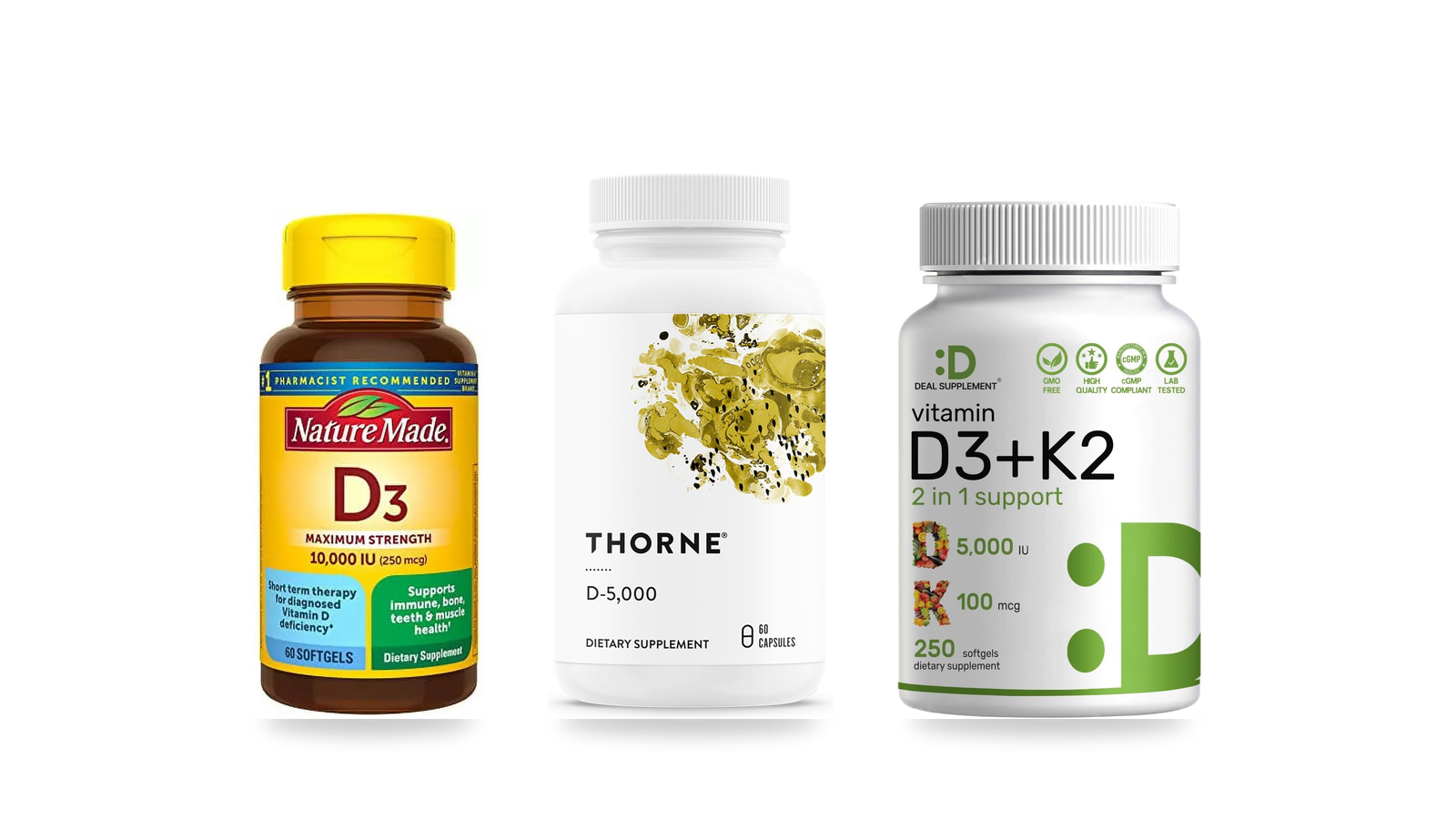
Vitamin D shelves are a wall of numbers: 1,000 IU, 2,000 IU, 5,000 IU, 10,000 IU — and newer labels add "mcg" next to them. This guide translates those numbers into plain English, using the exact bottles on our own shelf, and answers the question most shoppers actually have: how much is enough, and when is a bottle more than you need?
IU vs mcg: one simple conversion
For vitamin D, 40 IU = 1 mcg. That's the whole trick. US labels now show micrograms because the FDA updated the Supplement Facts format — the two numbers describe the same amount:
| Front label | Same amount in mcg | Example from our shelf |
|---|---|---|
| 1,000 IU | 25 mcg | Nature Made D3 1,000 IU — 180 softgels |
| 2,000 IU | 50 mcg | Nature Made D3 2,000 IU (50 mcg) — 400 tablets |
| 5,000 IU | 125 mcg | Nature Made Extra Strength D3 Gummies 5,000 IU (125 mcg) |
| 10,000 IU | 250 mcg | Nature Made D3 10,000 IU (250 mcg) — 60 softgels |
How much do adults actually need?
The NIH Office of Dietary Supplements recommends 600 IU (15 mcg) per day for adults up to 70, and 800 IU (20 mcg) after 70 — from all sources, including food and sunlight. The NIH also sets a daily safe upper limit for adults: 4,000 IU (100 mcg) from all sources, unless a healthcare provider advises otherwise.
Then why do 5,000 and 10,000 IU bottles exist?
Honest answer: those strengths are above the everyday upper limit, and they are meant for people whose blood tests showed low vitamin D and whose provider recommended a stronger dose. Even the manufacturer says so — the label on the 10,000 IU bottle above reads "short term therapy for diagnosed Vitamin D deficiency." If you haven't had your level tested, the everyday strengths (1,000–2,000 IU) are the usual starting territory — and a quick word with your doctor beats guessing.
D3 vs D2: does the letter matter?
Both forms raise your vitamin D level. D3 (cholecalciferol) is the form your skin makes in sunlight and the one in nearly every bottle we stock; NIH notes D3 may raise levels somewhat higher and for longer than D2. If your label says D3 — which it almost certainly does — you're looking at the standard modern form.
Why is K2 suddenly next to D3 on so many labels?
Pairing vitamin D3 with vitamin K2 (usually listed as MK-7) has become popular in bone-support routines, and several bottles on our shelf combine the two — for example Deal Supplement D3 5,000 IU + K2 100 mcg MK-7 or Horbäach D3 + K2 MK-7. One practical caution from the NIH: vitamin K can interfere with blood-thinning medication such as warfarin — if you take one, ask your provider before adding a K2 combo.
Softgel, gummy, tablet or drops?
Vitamin D is fat-soluble, so whatever format you choose, taking it with a meal that contains some fat is the easy win. Softgels dominate the aisle, gummies are the pleasant-tasting option (we've compared formats in Do gummies work as well as capsules?), and infant drops like Mommy's Bliss Vitamin D drops exist for babies — dosed strictly per your pediatrician. Timing questions? See Morning vs. night: when should you take vitamins?
Vitamin D options in our store
- Nature Made D3 2,000 IU — 400 tablets — everyday strength, bulk bottle
- Nature Made Extra Strength D3 Gummies 5,000 IU — 80 count — the gummy format
- Thorne D-5,000 — 60 capsules — practitioner-grade
- Nature Made D3 10,000 IU — 60 softgels — high-strength, for provider-guided use
- Deal Supplement D3 + K2 MK-7 — 250 softgels — the D3+K2 combo, big bottle
- Nature Made Zero Sugar D3 Gummies 2,000 IU — 110 count — the 50 mcg dose from this guide, in a sugar-free cherry gummy
- Nature Made Vitamin D3 + K2 Gummies — 50 count — the D3-with-K2 pairing covered above
- Nature Made Super D Immune Complex — 70 tablets — D3 combined with C, zinc and other companions
Browse every strength and combo in the Vitamin D collection — free US shipping included. Building a bone-support trio? Our magnesium guide covers the mineral that often rides along with D3 and K2.
Quick answers
Is 5,000 IU a day safe? It's above the NIH's 4,000 IU everyday upper limit. People use it when a provider recommends it after a blood test — that conversation is the right first step.
What does "5000 IU (125 mcg)" mean — two doses? No, one dose written two ways: 40 IU equals 1 mcg.
Do I need a supplement in summer? It depends on sun exposure, skin tone, latitude and age — there's no universal answer. A simple blood test settles it; ask your provider.
Not sure whether your levels are low in the first place? Our earlier piece on signs you may not be getting enough nutrients walks through what to watch for and when a blood test makes sense.
This article is for general information only and is not medical advice, diagnosis or treatment. Supplements are not intended to diagnose, treat, cure or prevent any disease. Talk to your healthcare provider before starting any supplement, especially if you take medication, are pregnant or nursing, or manage a health condition. Source: NIH Office of Dietary Supplements — Vitamin D Fact Sheet.