
Vitamin D3 is the shelf where one dose gets printed twice. On seven of the eight Supplement Facts panels read for this page, the vitamin D3 line carries a microgram figure and an IU figure side by side — 25 mcg (1,000 IU), 50 mcg (2000 IU), 125 mcg (5,000 IU), 250 mcg (10,000 IU) — and the eighth prints IU only. Above every line sits a serving size, and it is not the same on every bottle. We read all eight panels from bottles we sell, line up the printed pairs, do the arithmetic, and say where a line is not printed. As in the rest of this series, the panels are the subject here; what vitamin D3 does is not.
Eight panels, four serving sizes, eight vitamin D3 lines
Every panel states a serving size; on the Thorne panel it is the column header “One Capsule Contains:”. Four panels print “1 Softgel”, two print “1 Tablet”, and the gummy panel prints “2 Gummies”. The table copies each panel's vitamin D3 line for that serving, with the %DV as printed.
| Label | Serving size and vitamin D3 line |
|---|---|
| Nature's Bounty D3 25 mcg (1000 IU) Softgels | 1 Softgel: 25 mcg (1,000 IU), 125% DV |
| Nature Made Vitamin D3 2000 IU Tablets | 1 Tablet: 50 mcg (2000 IU), 250% DV |
| Nature Made Vitamin D3 + K2 Softgels | 1 Softgel: 125 mcg (5,000 IU), 625% DV |
| Nature Made Extra Strength Vitamin D3 Gummies | 2 Gummies: 125 mcg (5000 IU), 625% DV |
| Thorne Vitamin D3 5000 IU Capsules | One Capsule: (5,000 IU) 125 mcg, 625% DV |
| Deal Supplement Vitamin D3 + K2 MK7 Softgels | 1 Softgel: 5,000 IU, 625% DV (no mcg printed) |
| Nature Made Vitamin D3 10000 IU Softgels | 1 Softgel: 250 mcg (10,000 IU), 1250% DV |
| Bronson Organic Vitamin D3 10,000 IU Tablets | 1 Tablet: 250 mcg (10,000 IU), 1250% DV |
Seven of the eight lines print both units, and six of those seven put the micrograms first with the IU in parentheses. The Thorne panel is laid out differently: under the header “One Capsule Contains:”, the IU sits inside the ingredient name — “Vitamin D (as Vitamin D3) (5,000 IU)” — and “125 mcg” stands alone in the amount column. The Deal Supplement vitamin D3 line prints “5,000 IU” and nothing in micrograms; its %DV reads 625%, the same percentage the three 125 mcg panels print. On the other seven the %DV follows the micrograms: 125% at 25 mcg, 250% at 50 mcg, 625% at 125 mcg, 1250% at 250 mcg.
What the front prints vs what the panel prints
The front is read before the panel, and the fronts vary more than the panels.
- Nature's Bounty: front “25mcg (1000IU)”, micrograms first, no spaces, no comma; panel “25 mcg (1,000 IU)”.
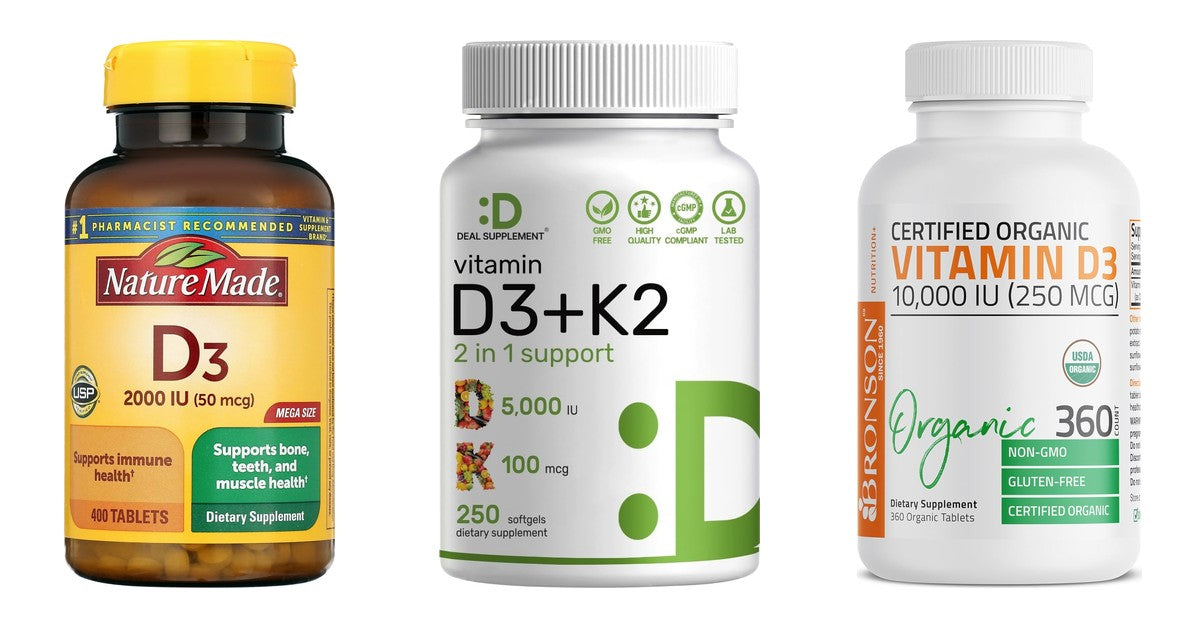
- Nature Made 2000 IU tablets: front “2000 IU (50 mcg)”; panel “50 mcg (2000 IU)” under “Amount Per Tablet”; the front also prints “MEGA SIZE”, “USP VERIFIED” and “400 TABLETS”.
- Nature Made D3 + K2 softgels: front “D3 + K2” and “30 SOFTGELS”, no dose in either unit; the 125 mcg (5,000 IU) figure is panel-only.
- Nature Made gummies: front “EXTRA STRENGTH”, “5000 IU (125 mcg)” and “per serving”. The serving is 2 Gummies; the front figure is the two-gummy figure.
- Thorne: front “D-5,000” and “60 CAPSULES”, a number with no unit; “5,000 IU” and “125 mcg” are panel-only.
- Deal Supplement: front “D3+K2”, “5,000 IU”, “100 mcg” and “250 softgels”. The “100 mcg” is the K2 figure, not the D3 in micrograms; the panel's D3 line stays in IU.
- Nature Made 10,000 IU softgels: front “MAXIMUM STRENGTH” and “10,000 IU (250 mcg)”; panel “250 mcg (10,000 IU)” under “Amount Per Softgel”.
- Bronson: front “CERTIFIED ORGANIC”, “VITAMIN D3” and “10,000 IU (250 MCG)”, unit in capitals; panel “250 mcg (10,000 IU)”.
Five fronts print both units, and four of those five lead with the IU; the Nature's Bounty front leads with micrograms. One front prints its D3 figure in IU only, one a number with no unit, one no dose. For the two units in general, see the IU to mcg and mg conversion chart.
Per piece: vitamin D3 1000 vs 2000 vs 5000 vs 10,000 IU once the serving size is read
On seven of the eight panels one piece is one serving, so the line in the table above is also the per-piece figure. The gummies are the exception: 125 mcg (5000 IU) per 2 Gummies, so one gummy carries 125 mcg ÷ 2 = 62.5 mcg, or 5000 IU ÷ 2 = 2,500 IU. The 5000 IU on the gummy front describes the serving, not the gummy.
With every line in micrograms the per-piece figures are 25, 50, 62.5, 125 and 250 mcg, plus one softgel printed in IU only. Comparing them is division:
- 125 mcg ÷ 25 mcg = 5: five Nature's Bounty softgels add up to one 125 mcg serving.
- 125 mcg ÷ 50 mcg = 2.5 Nature Made 2000 IU tablets; a half tablet is not something the label prints.
- 250 mcg ÷ 125 mcg = 2: two 125 mcg pieces equal one 250 mcg tablet or softgel; in gummies, two servings, 2 × 2 = 4 gummies (250 mcg ÷ 62.5 mcg = 4).
- 250 mcg ÷ 50 mcg = 5 tablets, or 250 mcg ÷ 25 mcg = 10 softgels, for the same 250 mcg.
Division is all this is; the printed directions are a separate matter. Nature's Bounty prints “For adults, take one (1) softgel daily, preferably with a meal.” Bronson prints “take 1 tablet daily, preferably with a meal”. The Nature Made 2000 IU panel prints “Adults, take 1 tablet daily with water and” before the photographed line is cut off. The Nature Made D3 + K2 and 10,000 IU softgel labels both print “Do not exceed one softgel daily or take with other supplements containing vitamin D.”, the gummy label prints “Do not exceed two gummies daily or take with other supplements containing vitamin D.”, and the 10,000 IU label adds that the product “is designed for short-term use”. Thorne and Deal Supplement directions were not photographed.
Servings per container: four panels print the line, four photographed panels do not
Four of the eight panels print a Servings Per Container line — 40 (gummies), 60 (Nature Made 10,000 IU), 250 (Deal Supplement), 360 (Bronson). The other four photographed panels do not, and for those we take the count from the front: “120 Rapid Release Softgels”, “400 TABLETS”, “30 SOFTGELS”, “60 CAPSULES”. Count times the per-serving figure gives the vitamin D3 in the whole bottle.
| Label and count | Vitamin D3 per container |
|---|---|
| Nature's Bounty, 120 softgels (front) | No panel line; 120 × 25 mcg = 3,000 mcg |
| Nature Made 2000 IU, 400 tablets (front) | No panel line; 400 × 50 mcg = 20,000 mcg |
| Nature Made D3 + K2, 30 softgels (front) | No panel line; 30 × 125 mcg = 3,750 mcg |
| Nature Made gummies, 40 servings | Panel line 40; 40 × 125 mcg = 5,000 mcg |
| Thorne, 60 capsules (front) | No panel line; 60 × 125 mcg = 7,500 mcg |
| Deal Supplement, 250 softgels | Panel line 250; 250 × 5,000 IU = 1,250,000 IU |
| Nature Made 10,000 IU, 60 softgels | Panel line 60; 60 × 250 mcg = 15,000 mcg |
| Bronson, 360 tablets | Panel line 360; 360 × 250 mcg = 90,000 mcg |
The gummy bottle needs one more step: 40 servings × 2 gummies = 80 gummies, a count the photographed front does not print. The Deal Supplement total stays in IU; its vitamin D3 line prints no other unit. And the biggest count is not the biggest total: 400 Nature Made tablets at 50 mcg come to 20,000 mcg, 360 Bronson tablets at 250 mcg to 90,000 mcg — 90,000 ÷ 20,000 = 4.5 times as much.
Vitamin D3 K2 softgels, calcium, sugars and the organic tablets: what else the panels print
Two of the eight panels add a vitamin K2 line, both on softgels with 5,000 IU of D3. The Nature Made D3 + K2 panel prints “Vitamin K2 (as all-trans Menaquinone-7)” at 100 mcg with an asterisk in the %DV column and the footnote “*Daily Value not established.” The Deal Supplement panel prints “Vitamin K2 (as Menaquinone) (MK-7)” at 100 mcg with 83% in that column. Same 100 mcg, two wordings of the K2 form, two different %DV entries. The other six panels print no K2 line.
The Nature Made 2000 IU tablet is the one panel with a mineral line: “Calcium (as Calcium Carbonate)” at 90 mg, 7% DV, which the front does not mention. The reverse case — calcium panels with a vitamin D3 line — is read in our calcium labels guide.
Only the gummy panel prints nutrition lines above the vitamin: Calories 15, Total Carbohydrate 3 g (1%**), Total Sugars 2 g (*) and the indented “Includes 2 g Added Sugars” (4%**), the asterisks pointing to footnotes; its other ingredients open with Glucose Syrup, Sugar, Water, Gelatin, Citric Acid, Pectin. The softgel panels list Soybean Oil, Gelatin, Corn Oil and glycerin (“Vegetable Glycerin” on Nature's Bounty) on the three Nature's Bounty and Nature Made softgels, plus “Colors Added (Including Carmine)” on the D3 + K2 softgel; Deal Supplement prints “Sunflower seed oil, natural carob” and a gelatin softgel. The Thorne capsule lists no oil: Microcrystalline Cellulose, a “Hypromellose (derived from cellulose) capsule”, Leucine, Silicon Dioxide and “Vitamin E (d-Alpha Tocopheryl)”.
Three front-label phrases, read against the panel. “EXTRA STRENGTH” on the gummies sits over 125 mcg (5000 IU) per two gummies; “MAXIMUM STRENGTH” on the Nature Made 10,000 IU softgels sits over 250 mcg (10,000 IU) per softgel; the Nature Made D3 + K2 softgel, also 125 mcg (5,000 IU) per piece, prints neither phrase. “Organic” belongs to Bronson alone: “CERTIFIED ORGANIC”, “USDA ORGANIC” and “360 Organic Tablets” on the front, and the word before every other ingredient, organic corn maltodextrin through organic guar gum.
Quick answers
What does a vitamin D3 5000 IU panel print in mcg? On this shelf, 125 mcg: the Nature Made D3 + K2 softgel prints “125 mcg (5,000 IU)”, the gummies “125 mcg (5000 IU)” per 2 Gummies, and Thorne “125 mcg” beside “(5,000 IU)”. The Deal Supplement panel prints “5,000 IU” only.
Vitamin D3 2000 vs 5000: what is the label difference? 50 mcg (2000 IU) at 250% DV per tablet against 125 mcg (5,000 IU) at 625% DV per softgel, capsule or two-gummy serving; 125 ÷ 50 = 2.5 of the 2000 IU tablets to one 5,000 IU serving.
Do the D3 gummies have 5000 IU per gummy? No. The panel prints 125 mcg (5000 IU) per serving of 2 Gummies; by division one gummy is 2,500 IU (62.5 mcg).
What is the mcg figure on a vitamin D3 10000 IU label? Both 10,000 IU panels print “250 mcg (10,000 IU)” at 1250% DV, one piece per serving; the fronts print “10,000 IU (250 mcg)” (Nature Made) and “10,000 IU (250 MCG)” (Bronson).
Printed pairs, serving sizes and counts are all this guide compares. The bottles are on our Vitamin D collection; the panel's vocabulary is covered in how to read a Supplement Facts label, and the two units in general in our earlier vitamin D3 IU vs mcg guide.
Where a photographed panel does not print the servings line, the count can be taken from the front — the same method used on three of the L-theanine and GABA panels.