
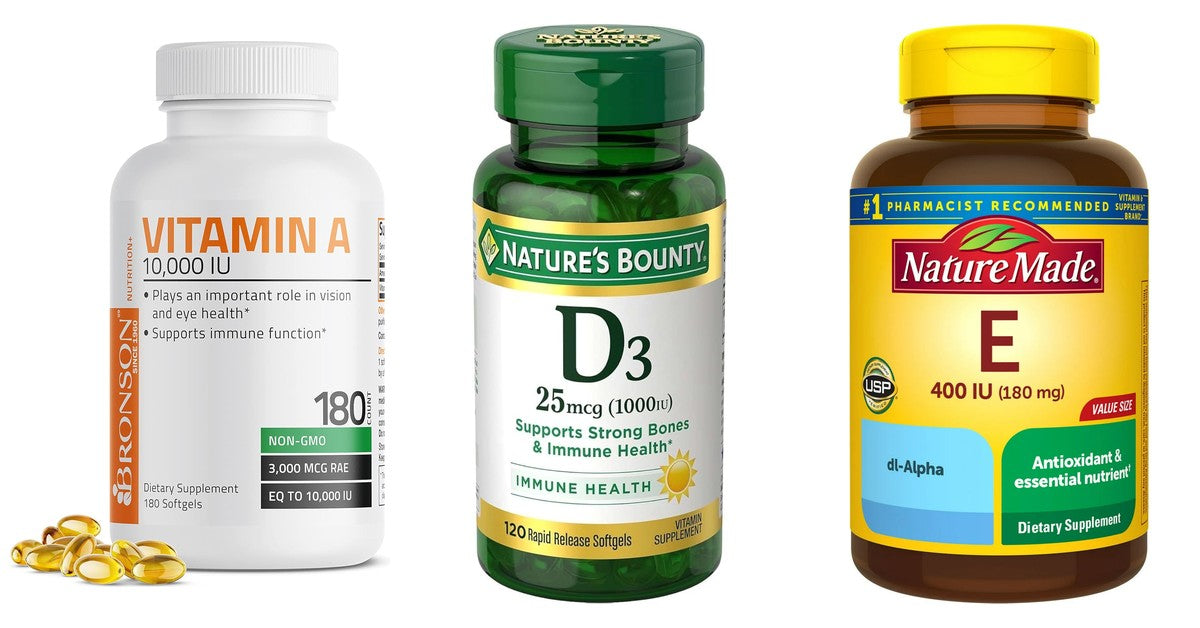
Vitamin labels used to count vitamins A, D and E in International Units (IU). The Supplement Facts rules FDA finalized in 2016 moved all three to weight: mcg RAE for vitamin A, mcg for vitamin D and mg for vitamin E. Many front labels still print IU, and some panels show it too, so one bottle can carry two numbers that look nothing alike. This page puts FDA's conversion factors for these three vitamins in one place, turns them into lookup tables, and tests the three factors that appear on our shelf — vitamin D, synthetic vitamin E and preformed vitamin A — against the labels of seven products we sell.
The factors, from FDA's own guidance
FDA's 2019 guidance for manufacturers, Converting Units of Measure for Folate, Niacin, and Vitamins A, D, and E on the Nutrition and Supplement Facts Labels, lists these multipliers:
- Vitamin D: IU × 0.025 = mcg — the same thing as 1 mcg = 40 IU. For this conversion, FDA counts D2 and D3 as equal. FDA also lets vitamin D labels show IU in parentheses next to the required mcg, which is why many D panels print both.
- Vitamin E: IU × 0.45 = mg for synthetic vitamin E (all-rac-alpha-tocopherol and its acetate or succinate esters); IU × 0.67 = mg for natural vitamin E (RRR-alpha-tocopherol and its esters). One IU number, two possible answers.
- Vitamin A: IU × 0.3 = mcg RAE for preformed vitamin A (retinol) and for supplemental beta-carotene — which FDA limits to purified beta-carotene in oil. Beta-carotene from food, including beta-carotene added to food or taken from a food source in a supplement, uses IU × 0.05; alpha-carotene and beta-cryptoxanthin from food use IU × 0.025.
The Daily Values behind the % column changed in the same rule: vitamin D from 400 IU to 20 mcg (800 IU), vitamin E from 30 IU to 15 mg, vitamin A from 5,000 IU to 900 mcg RAE. These are the Daily Values for adults and children 4 and older. A 400 IU vitamin D tablet that used to read 100% now reads 10 mcg and 50%.
Vitamin D: IU to mcg
| IU | mcg | % Daily Value (20 mcg) |
|---|---|---|
| 400 | 10 | 50% |
| 600 | 15 | 75% |
| 800 | 20 | 100% |
| 1,000 | 25 | 125% |
| 2,000 | 50 | 250% |
| 5,000 | 125 | 625% |
| 10,000 | 250 | 1,250% |
Going the other way, multiply mcg by 40: 5 mcg = 200 IU, 20 mcg = 800 IU, 50 mcg = 2,000 IU, 200 mcg = 8,000 IU.
Vitamin E: IU to mg — the form decides the answer
| IU | mg if synthetic (all-rac) | mg if natural (RRR) |
|---|---|---|
| 100 | 45 | 67 |
| 200 | 90 | 134 |
| 400 | 180 | 268 |
| 1,000 | 450 | 670 |
Labels rarely use the words all-rac or RRR. All three vitamin E labels on our shelf name their form as dl-Alpha Tocopheryl Acetate, and — as the next section shows — their numbers work only with the synthetic factor. The % column is built on 15 mg, so 400 IU of the synthetic form is 180 mg and 1,200%.
Vitamin A: IU to mcg RAE
| IU | mcg RAE (retinol, retinyl esters or supplemental beta-carotene in oil) | % Daily Value (900 mcg RAE) |
|---|---|---|
| 2,500 | 750 | 83% |
| 3,000 | 900 | 100% |
| 5,000 | 1,500 | 167% |
| 10,000 | 3,000 | 333% |
One caution comes straight from FDA: there is no single IU-to-mcg RAE factor for a product that mixes preformed vitamin A with beta-carotene, unless the split between them is known. On a multivitamin, read the mcg RAE figure the panel prints instead of converting the IU on the front.
Tested on our shelf: seven labels, three factors
Vitamin D — 1 mcg = 40 IU on every panel
- Nature’s Bounty D3 — panel: Vitamin D (as D3 Cholecalciferol) 25 mcg (1,000 IU), 125%, per 1 softgel. 1,000 × 0.025 = 25, and 25 ÷ 20 = 125%.
- Thorne D-5,000 — panel: Vitamin D (as Vitamin D3) 125 mcg with “(5,000 IU)” beside it, 625%, per one capsule.
- Horbäach Vitamin D3 — front: “10,000IU per serving”; panel: 250 mcg (10,000 IU), 1,250%, per serving of 2 quick release softgels. 10,000 × 0.025 = 250, and 250 ÷ 20 = 1,250%. The front number is per serving, so the serving size line belongs in the same reading.
Vitamin E — the % column shows which factor was used
- Nature Made Vitamin E — front: “400 IU (180 mg)” and “dl-Alpha”; panel: Vitamin E (as dl-Alpha Tocopheryl Acetate) 180 mg, 1200%, per 1 softgel. 400 × 0.45 = 180 — the synthetic factor — and 180 ÷ 15 = 12, or 1,200%.
- Deal Supplement Vitamin E — this panel still lists the amount in IU: 1,000 IU (as dl-Alpha Tocopheryl Acetate), 3,000%, per serving of 2 softgels. Run it backwards: 3,000% of 15 mg = 450 mg = 1,000 × 0.45. With the natural factor the same 1,000 IU would be 670 mg and about 4,467%, so the printed percentage confirms the synthetic factor.
- NatureBell Vitamin E — the same panel figures: 1,000 IU of dl-Alpha Tocopheryl Acetate per serving of 2 softgels, 3,000%.
Vitamin A — the IU moved to the front
- Bronson Vitamin A — front: “10,000 IU” plus “3,000 MCG RAE” and “EQ TO 10,000 IU”; panel: Vitamin A (as Retinyl Palmitate) 3,000 mcg RAE, 333%, per 1 softgel. Retinyl palmitate is preformed vitamin A, so 10,000 × 0.3 = 3,000, and 3,000 ÷ 900 = 333%. The panel carries only the mcg RAE figure; the IU appears on the front.
The % Daily Value check for adult labels
On labels for adults and children 4 and older, multiply the %DV by the Daily Value to get the weight when only one unit is printed: 125% × 20 mcg = 25 mcg of vitamin D; 3,000% × 15 mg = 450 mg of vitamin E; 333% × 900 mcg = about 3,000 mcg RAE of vitamin A. Labels for infants, children 1 to 3, or pregnant and lactating women use different Daily Values, so this shortcut does not apply to them. If your own conversion and the printed percentage disagree, check which form the label names, which group the % is built for, and whether the label still uses the older Daily Values (400 IU, 30 IU, 5,000 IU); supplement percentages are also rounded to the nearest whole percent.
Quick answers
How many mcg is 5,000 IU of vitamin D? 125 mcg (5,000 × 0.025).
How many IU is 50 mcg of vitamin D? 2,000 IU (50 × 40). 10 mcg is 400 IU and 20 mcg is 800 IU.
How many mg is 400 IU of vitamin E? 180 mg for synthetic vitamin E, such as the dl-Alpha Tocopheryl Acetate on the labels above; 268 mg for natural RRR-alpha-tocopherol.
Is 10,000 IU of vitamin A the same as 3,000 mcg RAE? For retinol, retinyl esters and purified beta-carotene in oil, yes (× 0.3). For food-source carotenoids or mixed sources, use the mcg RAE number on the panel.
What does IU mean? International Unit. FDA’s guidance describes it as “a measurement based on the biological activity or effect” — which is why the factor differs from vitamin to vitamin and, for vitamins A and E, from form to form.
This chart converts the units printed on a label; it does not say how much of any vitamin is right for you — that conversation belongs with your clinician. For the longer story behind vitamin D numbers, D2 versus D3, and why K2 sits next to D3 on so many bottles, see our vitamin D IU vs mcg guide. Browse the shelves these labels came from — Vitamin D and Vitamin E — or start with how to read a Supplement Facts label.