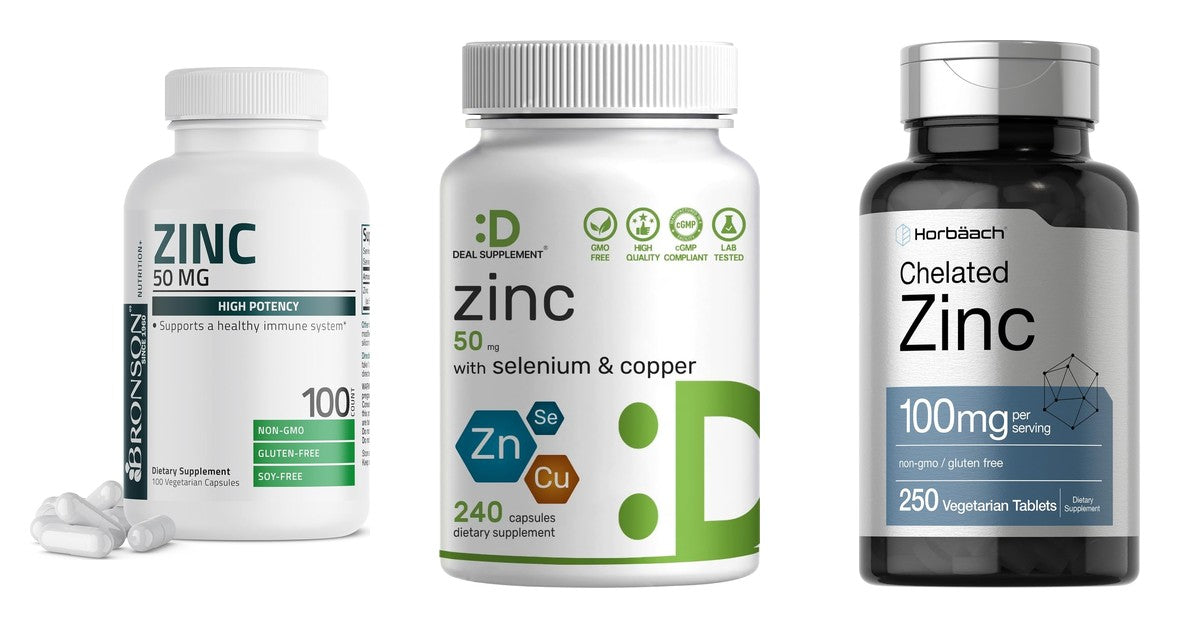
Six of the seven zinc fronts on our shelf carry a milligram figure: 20 mg, 30 mg, 30 mg, 50 mg, 50 mg and 100 mg. The seventh prints a formula name and no milligram figure. Read from the fronts alone, the two 50 mg bottles look alike and the 100 mg bottle looks like twice either of them. The Supplement Facts panels add the serving sizes and forms: one 50 mg line is a single zinc form in one capsule, the other splits between two forms in one capsule, the 100 mg line belongs to a two-tablet serving, and a third 50 mg line, on the bottle with no front figure, is spread across three capsules. Below, each panel is copied line by line, the zinc figure is divided by the serving size, and the companion rows on two of the panels are listed as printed. The standing rule of this series holds: printed quantities and the arithmetic between them, nothing about what zinc does.
Seven fronts, six milligram figures
The table pairs each bottle with its serving size and printed zinc figure; the exact wording of each panel line follows.
| Label | Serving size and zinc per serving |
|---|---|
| Nordic Naturals Zinc Glycinate 20 mg Capsules | 1 Capsule: 20 mg zinc, 182% DV |
| Bronson Zinc Glycinate 30 mg Capsules | 1 Capsule: 30 mg zinc, 273% DV |
| Thorne Zinc Picolinate 30 mg Capsules | One Capsule: 30 mg zinc, 273% DV |
| Bronson Zinc 50 mg Complex Capsules | 1 Capsule: 50 mg zinc, 455% DV |
| Deal Supplement Zinc with Selenium and Copper | 1 Capsule: 50 mg zinc, 455% DV |
| Horbäach Chelated Zinc 100 mg Tablets | 2 Vegetarian Tablets: 100 mg zinc, 909% DV |
| NatureBell Zinc, Quercetin, Vitamin C and D3 | 3 Capsules: 50 mg zinc, 455% DV |
Each zinc line as the panel prints it, next to the words on the front:
- Nordic Naturals, 20 mg: front “ZINC glycinate” and “20 mg ZINC”; panel “Zinc (as Zinc Glycinate)” 20 mg.
- Bronson, 30 mg: front “ZINC GLYCINATE”, “30 MG” and “100% Chelated Formula”; panel “Zinc (as Zinc Bisglycinate Chelate) (Albion™)” 30 mg.
- Thorne, 30 mg: front “Zinc Picolinate 30 mg”; panel “Zinc (as Zinc Picolinate)” 30 mg under the heading “One Capsule Contains:”, with 273% beside it.
- Bronson, 50 mg: front “ZINC” and “50 MG” with no form word; panel “Zinc (as 50% Zinc Oxide & 50% Zinc Picolinate)” 50 mg. The word complex in our listing name is not on the front; the two-form split appears only on the panel.
- Deal Supplement, 50 mg: front “zinc”, “50 mg” and “with selenium & copper”; panel “Zinc (as Zinc Picolinate)” 50 mg, one form.
- Horbäach, 100 mg: front “Chelated Zinc” and “100mg per serving”; panel “Zinc (as Zinc Gluconate)” 100 mg. The front’s own “per serving” points to the panel, where the serving is two tablets.
- NatureBell, no front figure: front “zinc + quercetin”, “vitamin C + D3”, “7 in 1 formula” and the name “Zinc Vanta™”; panel heading “Zinc Vanta™” with no amount, then “Zinc (25% Zinc Picolinate 25% Zinc Citrate 25% Zinc Glycinate 25% Zinc Gluconate)” 50 mg, printed over four lines without commas.
The two-form line and the four-form line print their shares as percentages; neither prints a milligram figure for any single form. For what these form names mean on a zinc line, and how the elemental figure relates to them, see our earlier zinc forms and elemental zinc guide; this page stays with the quantities.
How much zinc per capsule, and per tablet
Five of the seven panels set the serving at one capsule, and on those five the front figure is already the per-capsule figure. The other two need a division.
- Horbäach tablets: serving “2 Vegetarian Tablets”, zinc line 100 mg. 100 mg ÷ 2 = 50 mg per tablet. The 100 mg on the front is a two-tablet figure; one tablet carries the same 50 mg as one Bronson 50 mg capsule or one Deal Supplement capsule.
- NatureBell capsules: serving “3 Capsules”, zinc line 50 mg. 50 mg ÷ 3 ≈ 16.7 mg per capsule. The 50 mg here is a three-capsule figure.
Per piece, the seven figures run about 16.7 mg, 20 mg, 30 mg, 30 mg, 50 mg, 50 mg and 50 mg; three bottles reach 50 mg by three routes: one capsule of one form, one capsule of two forms, one tablet of a two-tablet serving.
Five labels print a directions line, and each states a count of pieces, not a milligram figure: Bronson glycinate “take one capsule daily, preferably with a meal”; Bronson 50 mg “take 1 capsule daily, preferably with a meal”; Deal Supplement “adults take one (1) capsule daily”; Horbäach “take two (2) vegetarian tablets daily, preferably with a meal”; NatureBell “adults take three (3) capsules daily”. The Nordic Naturals and Thorne directions were not photographed, and we quote nothing for them. Horbäach is the one tablet on this page, “250 Vegetarian Tablets” on the front; the other six fronts count capsules.
The %DV column, printed as printed
Every zinc line prints a %DV above 100 percent, copied here as it stands: 182% beside 20 mg, 273% beside 30 mg on both 30 mg panels, 455% beside 50 mg on all three 50 mg panels, and 909% beside 100 mg. The percentages rise in step with the milligrams: 182 ÷ 20 = 9.1, 273 ÷ 30 = 9.1, 455 ÷ 50 = 9.1 and 909 ÷ 100 = 9.09, within a hundredth of the same ratio on every line. The panels print the percentage; none of the seven photographed panels prints the reference amount it is computed from, and that reference figure is covered in the earlier zinc guide linked above rather than re-derived here.
%DV is a per-serving figure and divides the same way on the two multi-piece panels: Horbäach’s 909% per two tablets is about 455% per tablet (909 ÷ 2 = 454.5), and NatureBell’s 455% per three capsules is about 152% per capsule (455 ÷ 3 ≈ 151.7). Where the photographed panels print a footnote or footer line, the wording differs. Nordic Naturals heads the column “% Daily Value**” and prints “**Percent Daily Values are based on a 2,000 calorie diet.” Thorne closes its panel with a line that reads only “Daily Value (DV)”. NatureBell’s quercetin line carries “†” in place of a percentage, with the footnote “†Daily Value not established.”
Companion lines on the two combination panels
Five panels print a single zinc row and nothing else with an amount. Two print more, and every extra row is a per-serving figure.
Zinc, selenium and copper: one capsule, three rows
The Deal Supplement front prints “with selenium & copper” and three element tiles, “Zn”, “Se” and “Cu”. With the serving at 1 Capsule, each row is also a per-capsule figure:
- “Zinc (as Zinc Picolinate)” 50 mg, 455%
- “Copper (as Copper Glycinate)” 2 mg, 222%
- “Selenium (as Selenium Citrate)” 200 mcg, 364%
Two units share this panel: copper in milligrams, selenium in micrograms. 1 mg = 1,000 mcg; 200 ÷ 1,000 = 0.2. Written in one unit, a capsule holds 50 mg of zinc, 2 mg of copper and 0.2 mg of selenium. The photographed panel prints “SUGGESTED USE” above the facts and “STORAGE: Store in a cool, dark, dry place.” below them.
Zinc, quercetin, vitamin C and vitamin D3: three capsules per serving
The NatureBell serving is 3 Capsules, and the panel prints four amount rows beneath the “Zinc Vanta™” heading:
- Zinc (the four-form line quoted above) 50 mg, 455%
- “Quercetin (as Quercetin Dihydrate)” 1,000 mg, †
- “Vitamin C (as Ascorbic Acid)” 250 mg, 278%
- “Vitamin D3 (as Cholecalciferol)” 5,000 IU, 625%
Divided by three, one capsule carries about 16.7 mg of zinc, about 333 mg of quercetin (1,000 ÷ 3), about 83 mg of vitamin C (250 ÷ 3) and about 1,667 IU of vitamin D3 (5,000 ÷ 3). The vitamin D3 row is printed in IU only, with no microgram figure beside it. The front’s “7 in 1 formula” is not itemized on the photographed label; the panel names four zinc forms, quercetin, vitamin C and vitamin D3, and prints no line that ties the figure 7 to them.
Zinc per container
Servings per container multiplied by the per-serving figure gives the zinc in a whole bottle. Six panels print a servings figure. The Thorne panel prints “Serving Size: One Capsule” and no servings-per-container line; its count comes from the front, “180 CAPSULES”.
| Label | Zinc per container |
|---|---|
| Nordic Naturals, 60 capsules | 60 servings × 20 mg = 1,200 mg |
| Bronson 30 mg, 120 capsules | 120 servings × 30 mg = 3,600 mg |
| Thorne, 180 capsules | 180 capsules × 30 mg = 5,400 mg |
| Bronson 50 mg, 100 capsules | 100 servings × 50 mg = 5,000 mg |
| Deal Supplement, 240 capsules | 240 servings × 50 mg = 12,000 mg |
| Horbäach, 250 tablets | 125 servings × 100 mg = 12,500 mg |
| NatureBell, 240 capsules | 80 servings × 50 mg = 4,000 mg |
The two 240-capsule bottles hold 12,000 mg and 4,000 mg, a three-to-one gap (12,000 ÷ 4,000 = 3) that is entirely the serving size: one capsule against three, with 50 mg per serving on both. The 250-tablet bottle’s 12,500 mg checks both ways, 125 servings × 100 mg or 250 tablets × 50 mg, and on the six bottles that print a servings figure, servings times serving size equals the front count: 125 × 2 = 250 tablets, 80 × 3 = 240 capsules, and the four one-capsule bottles among them match one to one (60, 120, 100 and 240).
Quick answers
How much zinc is in one capsule? On five of the seven labels, exactly the front number: 20, 30, 30, 50 and 50 mg. On NatureBell, 50 mg per 3 capsules is about 16.7 mg per capsule; on Horbäach, 100 mg per 2 tablets is 50 mg per tablet.
Do the chelated zinc 100 mg tablets carry 100 mg each? Not by the panel. The Horbäach front prints “100mg per serving”, the panel sets the serving at “2 Vegetarian Tablets”, and the zinc line reads “Zinc (as Zinc Gluconate)” 100 mg. One tablet is 50 mg.
Is the 50 mg on the Bronson and Deal Supplement fronts the same thing? The number and the one-capsule serving are the same. The form lines differ: Deal Supplement prints “Zinc (as Zinc Picolinate)”; Bronson prints “Zinc (as 50% Zinc Oxide & 50% Zinc Picolinate)” with no milligram split between the two.
What does the zinc, selenium and copper label print per capsule? One capsule is one serving: zinc 50 mg (455% DV), copper 2 mg (222% DV), selenium 200 mcg (364% DV), the copper printed as “Copper Glycinate” and the selenium as “Selenium Citrate”.
Are the %DV figures above 100 percent really printed that way? Yes. 182%, 273%, 455% and 909% are the printed figures beside 20, 30, 50 and 100 mg; we copy them as printed and add no comment.
Everything above is read from seven labels, and the comparison stops at the printed numbers. The bottles are on our zinc collection page; the 250 mg vitamin C row on the NatureBell panel can be set beside the 500, 1,000 and 2,000 mg tablets in our vitamin C per-tablet label read; and the layout of the panel itself is walked through in how to read a Supplement Facts label.
On these seven zinc panels the front figure is the per-capsule figure five times out of seven; the opposite shelf, where a front prints 500 mg or 1330 mg and the magnesium row prints 90 mg or 240 mg, is divided out in our magnesium per capsule vs per serving read of nine labels.