
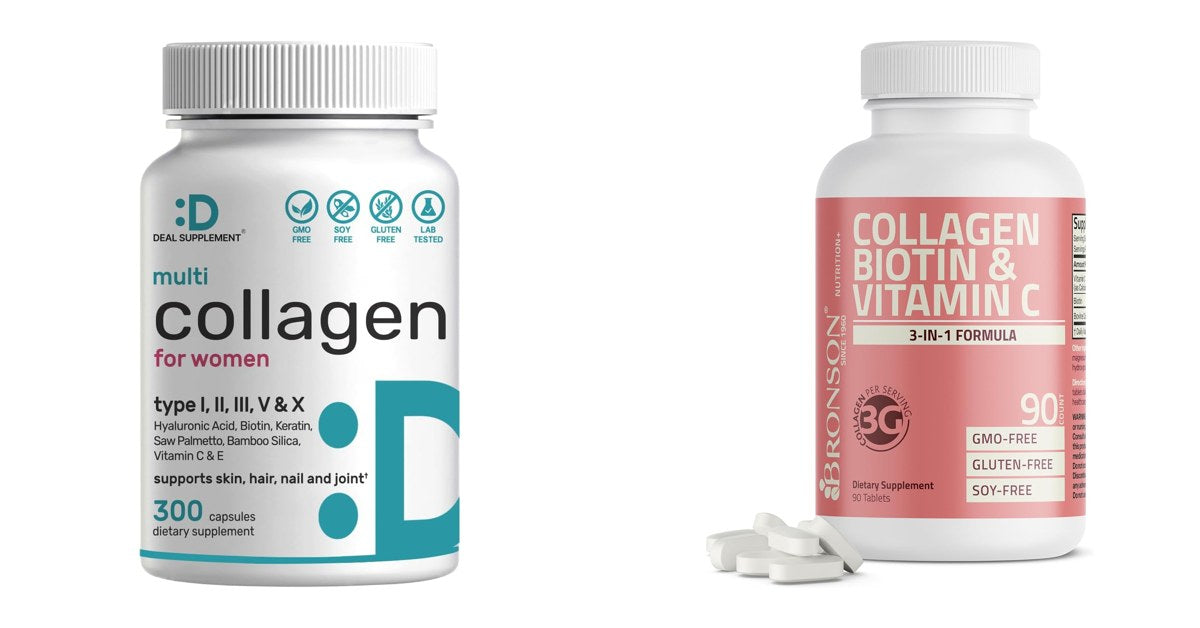
Collagen labels have their own vocabulary — Roman-numeral types, “peptides”, gram doses where other supplements use milligrams, and side ingredients whose %DV runs into five digits. This guide decodes each of those, using two collagen products from our own shelf whose Supplement Facts panels we read line by line. As always in this series: label math only, no claims about what collagen does.
The Roman numerals are source types
Collagen proteins are classified into numbered types. Labels that blend several sources say so in the panel: Multi Collagen Peptides Capsules for Women prints, as listed: “Multi Collagen Complex (type I, II, III, V & X) — 1,000 mg”, with the sources itemized beneath it: bovine, chicken, marine, and eggshell-membrane collagen peptides. A single-source label is simpler: Bronson Collagen Peptides prints one row, “Bovine Collagen Peptides — 3 g”. Neither style is “more honest” than the other — the reading skill is simply knowing that the numerals describe where the collagen comes from, and that the panel names the animal sources outright (useful if you avoid fish or egg: the multi-collagen panel above prints “CONTAINS: Fish and egg”).
“Peptides” on the front, gelatin in the capsule
“Collagen peptides” (also called hydrolyzed collagen) means the protein has been broken into smaller fragments. Here is a label detail worth a smile: the multi-collagen product above delivers its peptides inside a gelatin capsule — the Other Ingredients line prints “gelatin (capsule)”, and gelatin is itself cooked-down collagen. Nothing misleading about it; it is just the kind of detail only the Other Ingredients line will tell you. Vegetarians and vegans should know that both products here are animal-derived through and through.
Grams, not milligrams — compare like for like
Collagen doses are usually grams. The two panels above: 1,000 mg (1 g) per 3-capsule serving for the multi-collagen blend, and 3 g per 3-tablet serving for Bronson (that is 1 g per tablet — and the store title says “3000mg Per Serving” for exactly this reason). Powders on the market often run higher per scoop; capsule and tablet formats trade dose for convenience. Whatever the format, the comparison only works serving-to-serving: 3 capsules vs 3 tablets here, with printed servings per container of 100 (300 capsules) and 30 (90 tablets) respectively — both match the count math.
No %DV for collagen — but watch the neighbors
Collagen rows carry the dagger/asterisk footnote “Daily Value not established” — there is no official Daily Value for collagen. The five-digit percentages you see on these labels belong to the companion ingredients, and they are checkable arithmetic. The multi-collagen panel prints Biotin 5,000 mcg — 16,667%, and Bronson prints Biotin 2500 mcg — 8333%. Both figures confirm the same Daily Value base: 30 mcg (5,000 ÷ 30 = 16,667%; 2,500 ÷ 30 = 8,333%). A giant %DV is not a typo — it is a big dose divided by a small reference value, printed honestly. The same panels also show ordinary-scale rows (vitamin C at 56% and 33% respectively), which makes the contrast easy to see on one label.
Shelf checklist
- Types (I, II, III…) = source classification; the panel names the animal sources.
- Check the allergen line — marine and egg sources are printed there.
- Compare grams per serving, and note how many capsules/tablets a serving is.
- “Daily Value not established” is normal for collagen itself.
- Five-digit %DV on biotin? Divide the mcg by 30 and it will match the print.
Both products above live in our vitamins & supplements collection; for the general skill of reading any panel, start with How to Read a Supplement Facts Label and the rest of our label-math series, such as the magnesium forms guide.
This article is general label-reading information, not medical advice and not a statement about what any ingredient does in the body. Dosing needs differ from person to person; talk with your doctor, pharmacist or registered dietitian before starting or changing any supplement, especially if you are pregnant, nursing, taking medication or managing a condition.
For the capsule-versus-powder arithmetic — how many capsules or tablets add up to one 10 g scoop — see Collagen Capsules vs Powder: Four Labels, Gram by Gram.