Collagen comes to our shelf in three shapes: a powder measured by the scoop, tablets and capsules measured by the piece — and the panels print the collagen in grams on two of them and in milligrams on the other two. Put them side by side and the numbers look like they belong to different products — 10 g on one panel, 1,000 mg on another, 2,000 mg of a blend on a third. They are all the same unit once you move the decimal point. This page reads four Supplement Facts panels from products we sell, puts the three printed collagen figures in one unit, notes the one panel that does not print a figure, and works out how many capsules or tablets add up to one scoop of powder. As in every guide in this series: label math only, no claims about what collagen does.
Four labels, four serving sizes
The first thing the panels disagree on is what a “serving” is. The powder counts a scoop; the tablet and capsule bottles count three or four pieces. Here is what each panel prints, read line by line from the bottles.
| Label | Serving size and collagen per serving |
|---|---|
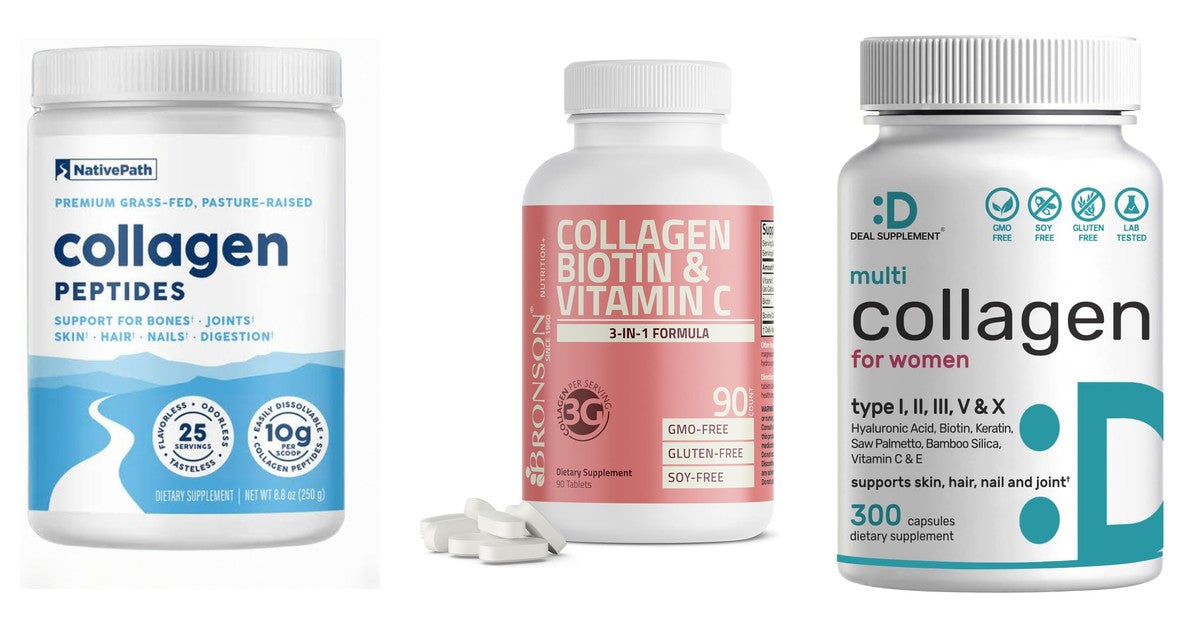
| NativePath Collagen Peptides (powder) | 10 g, about 1 scoop: 10 g hydrolyzed bovine collagen (types I and III) |
| Bronson Collagen, Biotin and Vitamin C (tablets) | 3 tablets: 3 g bovine collagen peptides |
| Deal Supplement Multi Collagen for Women (capsules) | 3 capsules: 1,000 mg multi collagen complex (types I, II, III, V and X) |
| NatureBell Hyaluronic Acid with Collagen and MSM (capsules) | 4 capsules: collagen not printed separately, part of a 2,000 mg blend |
Two of the four print their collagen in grams, one in milligrams, and one only as an unweighed component of a 2,000 mg blend. The conversion is the easy part: 1 g = 1,000 mg, so 10 g is 10,000 mg and 3 g is 3,000 mg. Written in the same unit, the per-serving figures are 10,000 mg, 3,000 mg and 1,000 mg — a ten-to-one range between the powder and the capsule — plus one panel that does not say.
How many capsules make one scoop?
Once everything is in milligrams, the scoop question is division. One NativePath scoop carries 10,000 mg of collagen.
- Deal Supplement capsules: 1,000 mg per 3 capsules is about 333 mg per capsule. 10,000 mg ÷ 333 mg ≈ 30 capsules, which is 10 of the label’s 3-capsule servings.
- Bronson tablets: 3,000 mg per 3 tablets is 1,000 mg per tablet. 10,000 mg ÷ 1,000 mg = 10 tablets, which is 3⅓ of the label’s 3-tablet servings.
- NatureBell capsules: cannot be calculated. The panel lists hyaluronic acid, MSM and hydrolyzed bovine collagen together as a 2,000 mg proprietary blend without a figure for each, so the collagen in one capsule is somewhere between a trace and 500 mg — the panel prints the blend total and lists collagen third of the three, but no figure for it.
This is arithmetic, not a recommendation. Three of the labels print directions — NativePath says “Add 1-2 scoops to 8 ounces of hot or cold liquid”, Bronson’s directions say “As a dietary supplement for adults, take 3 tablets daily”, Deal Supplement’s suggested-use line says “adults take three (3) capsules daily” — and the math above only shows how the quantities on the panels compare.
Collagen per container, not just per serving
Serving size also hides how much collagen a whole bottle or tub holds. Multiplying the per-serving figure by the servings printed on the panel gives the container total.
| Label | Collagen per container |
|---|---|
| NativePath powder, 8.8 oz (250 g) | 25 servings × 10 g = 250 g |
| Bronson, 90 tablets | 30 servings × 3 g = 90 g |
| Deal Supplement, 300 capsules | 100 servings × 1 g = 100 g |
| NatureBell, 240 capsules | 60 servings; collagen not printed |
For NatureBell the container total cannot be filled in: 60 servings of a 2,000 mg blend is 120 g of blend, and that figure would equal the collagen only if the whole blend were collagen, which the panel does not say. The NativePath tub is the clearest case because its ingredient list is one item long — “Hydrolyzed Bovine Collagen (Types 1 and 3)” — so the 250 g net weight and the 250 g of collagen are the same number. The 300-capsule bottle, the largest count on the table, holds 100 g of collagen; the 90-tablet bottle holds 90 g. Count and grams are different things.
What the powder panel prints that these three capsule and tablet panels don’t
The powder serving is 10 g; its panel carries lines the other three panels do not print. NativePath prints Calories 35, Protein 9 g and Sodium 50 mg (2% DV) above the collagen line. The three tablet and capsule panels print no calorie or protein line at all; their collagen figures are 1 to 3 g per serving, and what they list instead are the vitamins and other ingredients that share the capsule.
- Bronson (3 tablets): Vitamin C 30 mg (33% DV), Biotin 2,500 mcg (8,333% DV), bovine collagen peptides 3 g.
- Deal Supplement (3 capsules): Vitamin C 50 mg (56% DV), Vitamin E 15 mg (100% DV), Biotin 5,000 mcg (16,667% DV), the 1,000 mg collagen complex, saw palmetto 100 mg, hydrolyzed keratin 100 mg, bamboo extract 50 mg, hyaluronic acid 50 mg. The allergen line reads “CONTAINS: Fish and egg.”
- NatureBell (4 capsules): the 2,000 mg blend only, with rice flour, magnesium stearate, silicon dioxide and a gelatin capsule listed as other ingredients.
The five-digit biotin percentages are a separate story; our biotin label guide walks through why 2,500 mcg reads as 8,333% and 5,000 mcg as 16,667%.
Where the collagen comes from, as printed
Each panel also names the source. NativePath and Bronson print bovine collagen; NatureBell prints hydrolyzed bovine collagen inside its blend. Deal Supplement’s complex lists four sources under the 1,000 mg line — bovine, chicken, marine and eggshell membrane collagen peptides. Its front label and panel print five type numbers (I, II, III, V and X); the single-source powder prints two (I and III). Neither label says which source carries which type, and the panel does not say how the 1,000 mg is divided between the four sources. For what the Roman numerals mean, see Collagen Labels Decoded.
Quick answers
Is NativePath collagen hydrolyzed? Yes, by its own panel: the ingredient line reads “Hydrolyzed Bovine Collagen (Types 1 and 3)”, and the Supplement Facts line repeats “Hydrolyzed Bovine Collagen (Types I & III) 10 g”.
Does the NativePath label list amino acids? No. The panel prints calories, protein, sodium and the collagen line; it does not print an amino acid breakdown.
What do the NativePath directions say? The printed directions: “Add 1-2 scoops to 8 ounces of hot or cold liquid. Stir or froth until completely dissolved.” A serving is 10 g, printed as “about 1 scoop”; the panel prints 25 servings per container.
Collagen pills vs powder — which has more collagen? On the three labels that print a collagen figure, the powder serving (10 g) is more than three times the tablet serving (3 g) and ten times the Deal Supplement capsule serving (1 g); the NatureBell capsule serving cannot be compared because its collagen figure is not printed. Per piece, one Bronson tablet carries 1,000 mg and one Deal Supplement capsule about 333 mg.
Why do these capsule and tablet panels not print protein? The labels do not say why; they simply do not carry the line. The powder, with a 10 g serving, prints 9 g of protein — collagen is a protein, and NativePath’s single-ingredient panel makes that visible.
What is a proprietary blend? A panel line that gives one total weight for several ingredients without stating each one’s share. NatureBell’s 2,000 mg blend of hyaluronic acid, MSM and collagen is the example on this page; the total is printed, the split is not.
This guide compares the quantities printed on four labels and nothing more. Browse the shelf these labels came from on the collagen collection, compare bottles by cost per serving rather than per bottle with our cost per serving study, or start with how to read a Supplement Facts label.