
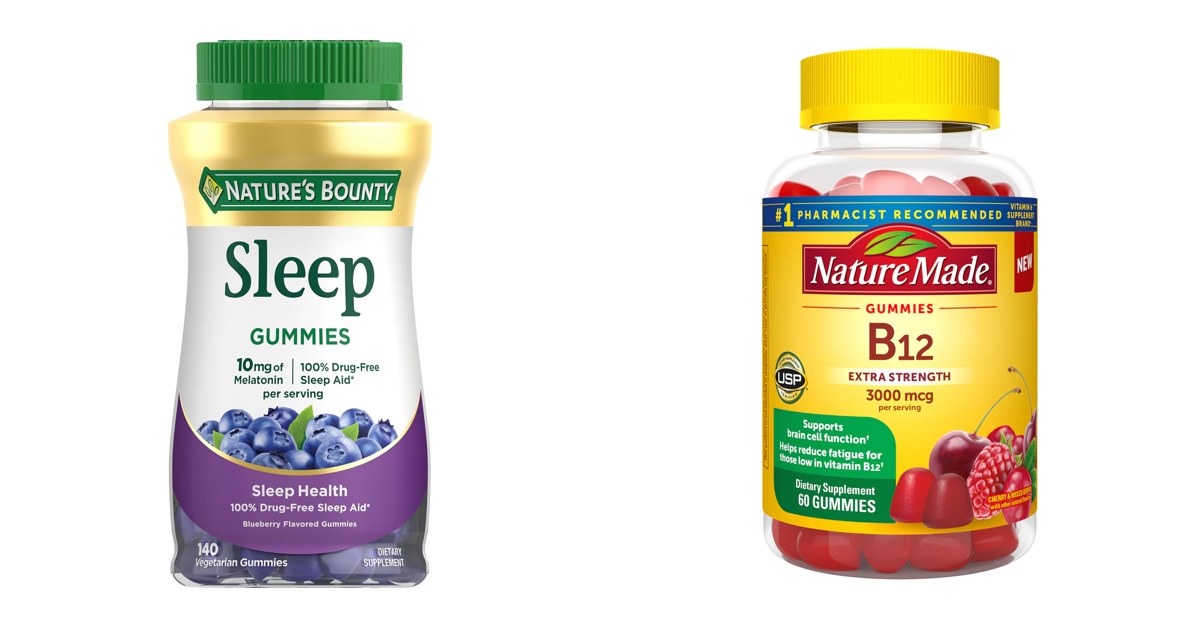
The biggest number on a gummy vitamin bottle is almost never the amount in one gummy. On most labels it is the amount in one serving — and for gummies, a serving is very often two pieces. This guide walks through exactly where to find that on the label, with real examples from products on our own shelf, panels read line by line.
The three lines that settle it
Every dietary-supplement gummy carries a Supplement Facts panel with the same three lines. Read them in this order:
- Serving Size — how many gummies the numbers below describe (e.g. “2 Gummies”).
- Amount Per Serving — the dose for that many gummies, not for one.
- Servings Per Container — how many of those servings the bottle holds.
If you take one gummy when the serving size is two, you are getting half of every number on the panel. If you take two when you meant one, you doubled it. Neither is automatically wrong — it depends on what you and your health professional intended — but the label math should be a decision, not an accident. (For the full anatomy of the panel, see our guide How to Read a Supplement Facts Label.)
Real example 1: melatonin, 10 mg — per two gummies
The Supplement Facts panel on Nature’s Bounty Sleep Gummies (melatonin 10 mg per serving) reads, as printed: “Serving Size 2 Gummies” and “Melatonin 10 mg” in the Amount Per Serving column. The arithmetic: 10 mg ÷ 2 gummies = 5 mg in each gummy. Someone who assumes “one gummy = 10 mg” and takes two is actually taking 20 mg. This is why our own store title for this product says “10 mg Per Serving” — the qualifier is the point. Melatonin also has no % Daily Value on the panel (the column shows the “***” footnote, “Daily Value not established”), because it is a hormone, not a vitamin or mineral with an established Daily Value.
Real example 2: the front says “per serving” in small print
The front label of Nature Made B12 Gummies Extra Strength prints a big “3000 mcg” — and directly under it, in much smaller type, “per serving”. That two-word qualifier is easy to miss at shelf distance, and it changes the meaning of the big number entirely. Whenever a front label shows a dose, look for the words “per serving” nearby, then turn the bottle and find the Serving Size line to see how many gummies that serving is.
Gummies carry food lines, too
Because gummies are chewable candy-format products, their panels usually include rows that capsules rarely have. On the melatonin panel above, the printed rows include Calories 15, Total Carbohydrate 4 g, Total Sugars 3 g and “Includes 3g Added Sugars — 6%” per two-gummy serving. If you follow added-sugar intake, the gummy format is part of that math; a capsule or tablet version of the same nutrient typically is not.
A 60-second checklist at the shelf
- Find Serving Size first. One gummy or two?
- Divide the big number by the serving size to get the per-gummy amount.
- Check Servings Per Container: a “140-count” bottle at 2 per serving is 70 servings, not 140.
- Scan for Added Sugars and calories if that matters to you.
- Any asterisk or dagger next to a number points to a footnote — read it; it usually says “Daily Value not established.”
Browse the gummy and non-gummy options side by side in our vitamins & supplements collection — every product page on our store states doses the way the panel prints them, serving-qualified.
This article is general label-reading information, not medical advice and not a statement about what any ingredient does in the body. Dosing needs differ from person to person; talk with your doctor, pharmacist or registered dietitian before starting or changing any supplement, especially if you are pregnant, nursing, taking medication or managing a condition.